By Tina T. Meeks, SCOREE Services LLC
Got off the phone with my daughter Brianna, who co-owns SCOREE Services with me, and we landed on the same topic firms call us about all the time: security deposit allocation. Which bucket does the money belong in? Firms keep mixing up income accounts and damage charge accounts, and that one mix-up ripples through the resident ledger, the owner statement, the 1099s, and the tax return.
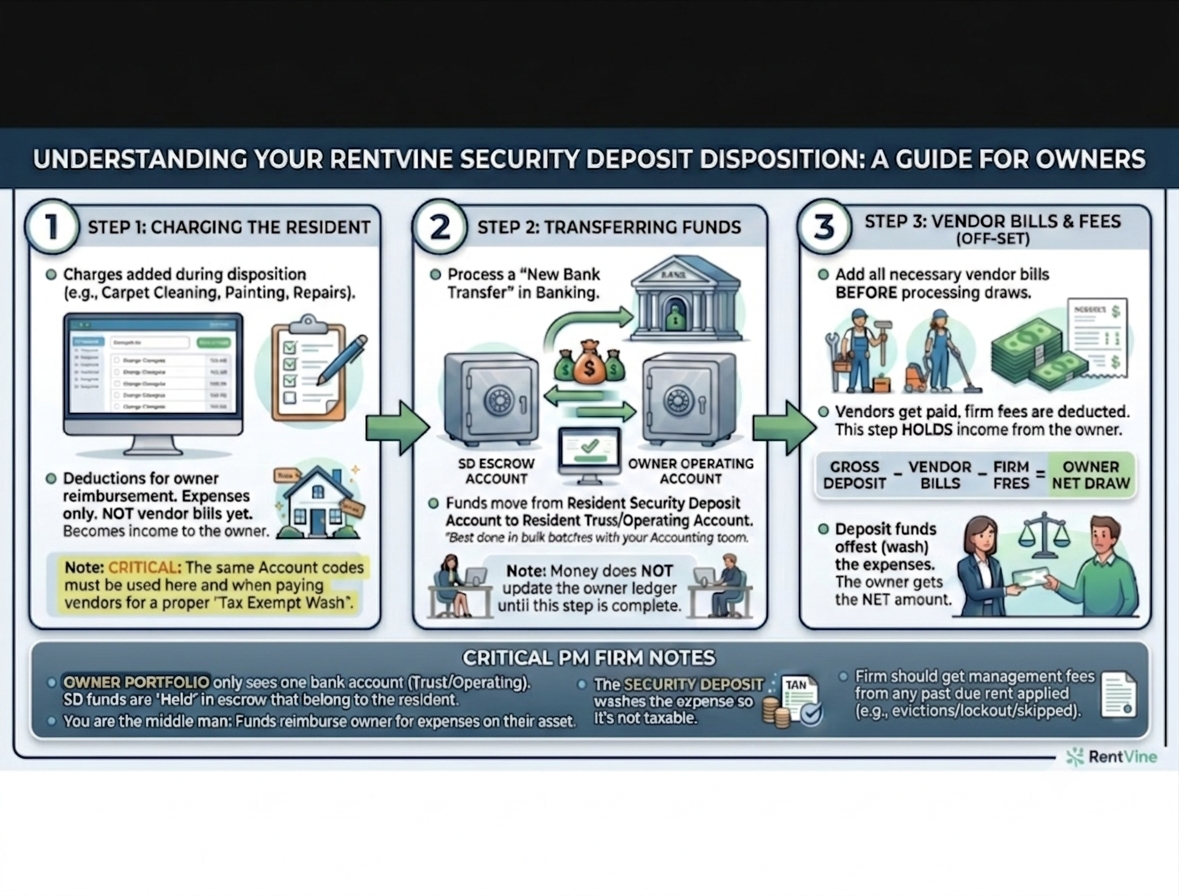
So let us walk it through, one forkful at a time. I even made a flowchart I hand to owners that lays out the three steps. This is the firm-side version.
The two buckets
A damage charge account is where you book what the resident owes for validated damage. An income account is where the owner's real revenue lives. They do different jobs, and they are not interchangeable.
The $150 example
Say a resident causes $150 in damage, and the damage is validated under the Security Deposit Act. (More on what "validated" means in a minute.)
Step one, you charge the resident ledger $150 on the damage charge account. That charge is what allows you to pull from the security deposit, which moves the money from the SD escrow account to the owner's operating account. On most software workflows, you have to move the funds before the owner ledger updates, just like the illustration shows.
Step two, the vendor bill comes in for the repair, and it posts to that same charge account. Same account codes on both sides. That is the critical part. Now the account shows $150 in from the deposit application and $150 out to the vendor. The deposit funds offset, or wash, the expense. The owner gets the net amount, and the statement balances. Two entries, one account, nothing left hanging. That is what correct looks like.
The trap: treating damage money like income
Here is where firms get tangled. They book damage charges to an income account, and suddenly the books tell a story that is not true.
Rental income is a different process with different rules. When a security deposit is applied to back rent, that IS income to the owner. That is the one scenario where the management company can earn its fee off the deposit, based on the property management agreement. Think evictions, lockouts, skips. And that income belongs on the owner's 1099.
Damage reimbursement is not income. The $150 came out of the resident's deposit. It did not come out of the owner's pocket. So the owner should not be taking that repair as a tax deduction either. The money that paid for it was never theirs. The deposit washes the expense, so it is not taxable. (Their CPA can confirm the rest. We are not the tax people.)
Do not forget the vendor
The vendor who did the repair is a real vendor, and they get a 1099 like any other vendor. Run an in-house maintenance team? Set up an in-house vendor code and track their repairs the same way. If the work is not tracked under a vendor code, it disappears from your reporting, and that is how firms lose the paper trail.
What you can actually charge the resident
Two documents control this: the lease and the Security Deposit Act. I am keeping this part general on purpose, because the legal side belongs to the licensed folks. What I will say is what protects you. Wear and tear is not damage, and the law treats them differently. Paint and carpet have life expectancies, and those expectancies are not the same. Photos and validation from a certified vendor are what stand up when a resident disputes a charge. If you cannot prove it, do not charge for it.
The stakes are higher than most firms think
In North Carolina, the landlord has to itemize every deduction in writing and mail or deliver it with the remaining balance within 30 days of the tenancy ending. That is N.C.G.S. 42-52. Most states require a written itemized statement too. A few do not spell it out, but the safe move is to itemize everywhere. A resident who is just told "you lost your deposit" has every right to ask for the receipts and the breakdown.
Get the allocation wrong on purpose, and it gets expensive fast. Most states let a tenant sue for two to three times the deposit, and some add attorney's fees on top. A sloppy deposit disposition can cost multiples of the deposit itself.
Where SCOREE draws the line
I want to be clear about this. SCOREE Services does not allocate security deposits. That is legal work. We are not brokers and we are not licensed property managers, and the person who reconciles and signs off on a deposit has to be one. What we will do is answer your accounting questions and help you understand the buckets, so every entry lands in the right place once the licensed person makes the call on how it moves through your software, once your settings are understood.
And when a firm wants the legal side straight from the source, I bring in an eviction attorney who knows the Security Deposit Act cold. He is joining us as a guest inside the Skool community for this exact topic.
This is becoming a course
The full version of this, the buckets, the entries, the wash, and everywhere firms go wrong, is becoming a course inside the Crack the PM Code Skool community. The kind of knowledge that protects your license and your owners at the same time.
Come join us in the Skool community and follow along for more: https://www.skool.com/scoree-services-llc-8547/about
If your owner statements never quite wash for this reason, we can find the leaks with SCOREE Services LLC